
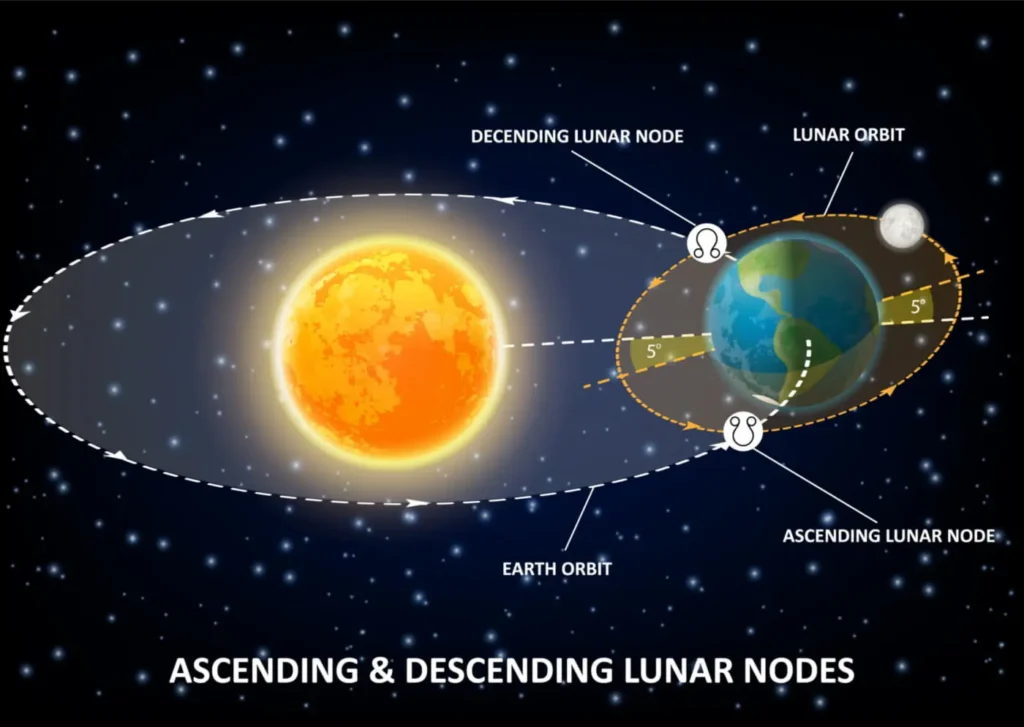
The Lunar Nodes are among the most easily misunderstood points in a horoscope. They are often described in dramatic language – destiny, karma, past lives, soul contracts – yet a useful nodal reading is usually quieter and more precise. It asks two practical questions: What pattern comes so naturally that you may overuse it? And what kind of experience feels less automatic, but gradually makes your life larger?
In modern Western astrology, the South Node is commonly associated with inherited or already-developed patterns, while the North Node describes a direction of development. Some astrologers read this literally through reincarnation; others treat it psychologically, as the movement from familiar conditioning toward less practiced capacities. Both approaches can work as symbolic frameworks, and neither requires us to declare that one end of the axis is “bad” and the other “good.” Astrodienst’s overview makes the same essential point: the task is not to abandon the South Node, but to use its experience in service of the North Node.

What Lunar Nodes Actually Are
A lunar node is not a planet, asteroid, or physical object. Astronomically, the Moon’s orbital plane is tilted by about 5.145 degrees to the ecliptic, the apparent path of the Sun against the sky. The two places where the Moon’s orbit crosses the ecliptic are the nodes. At the ascending or North Node, the Moon crosses from south to north of the ecliptic; at the descending or South Node, it crosses from north to south. The two points form one axis and therefore sit opposite each other in the zodiac.
This geometry explains why the nodes are inseparable from eclipses. A solar or lunar eclipse can occur only when a New Moon or Full Moon forms sufficiently close to the nodal axis. The nodes themselves regress through the zodiac, completing a cycle in roughly 18.6 years. That astronomical rhythm later became rich symbolic material for astrology, where the nodal axis is read as a line connecting two complementary modes of experience.
Do not confuse the Lunar Nodes with your Moon sign. The Moon sign describes the zodiacal sign occupied by the physical Moon at birth and is generally read in astrology as part of the emotional and instinctive nature; the nodes are calculated crossing points. Readers who want to see how an actual Moon placement is interpreted can compare this nodal logic with a Moon-sign interpretation on VedAstrologer.
You may also notice chart software offering a “True Node” or “Mean Node.” The mean position smooths the node’s irregular motion and remains retrograde; the true position follows its oscillations more closely and can briefly move direct. Both are established astrological choices. Astrodienst notes that their positions remain relatively close, so the choice matters most when a node sits near a sign cusp or forms a very tight aspect.
The South Node: Memory, Skill, and the Comfort Trap
The South Node is often called the karmic past, but “past” is more useful when we understand it broadly. It can describe habits learned early, family conditioning, talents that seem strangely effortless, familiar relationship strategies, or – in reincarnation-based astrology – capacities carried from earlier lives. The common denominator is familiarity. The South Node tends to feel known before we consciously decide that it is important.
That familiarity is a resource. A South Node in the 3rd house, for instance, may suggest ease with immediate information, local networks, practical communication, or the quick exchange of facts; the opposite North Node in the 9th invites a wider frame – sustained study, philosophy, travel, teaching, publishing, or a more coherent worldview. The mistake would be to silence the 3rd house in order to “become” the 9th. Better astrology asks how strong communication skills can carry a bigger idea.
The shadow appears when competence turns into reflex. We retreat to the South Node under pressure because it gives fast certainty. Someone with a South Node in Libra may keep negotiating long after a clean personal decision is needed; South Node in Capricorn can default to control and duty when vulnerability would be more honest. A South Node in the 10th may hide inside achievement because private life feels less measurable. These are examples of the familiar-versus-developmental logic used in modern nodal astrology, not fixed predictions about every person with those placements.
This is why “release your South Node” is poor advice. You cannot build a mature life by amputating a developed part of yourself. The South Node is the toolkit; trouble begins only when every problem is treated as if it needs the same tool. Modern psychological interpretations of the nodes likewise emphasize integration of the axis rather than a simple rejection of the descending node.
The North Node: Growth Without Self-Rejection
The North Node is commonly described as a future-oriented point: unfamiliar territory, a developmental task, or a quality that asks for conscious practice. In the language of modern evolutionary astrology, it can feel like a stretch because it does not initially carry the same automatic confidence as the South Node. Astrological sources aimed at both serious students and general readers repeatedly frame the axis this way – familiar South Node patterns opposite a North Node direction that must be cultivated.
At first a North Node experience may feel clumsy: an Aries North Node says “choose” before consensus is guaranteed; Taurus says “slow down” when intensity is addictive; Gemini says “ask another question” when certainty feels safer; Cancer says “feel this” when competence has become armor. With repetition ,the unfamiliar becomes inhabitable. Eventually the person can move between both ends of the axis with more freedom. These sign polarities follow the developmental model found across contemporary nodal interpretations.
It also helps to stop treating the North Node as a job title or a single event. A 7th-house North Node does not simply mean “get married,” just as a 10th-house North Node does not mean “become famous.” Houses describe fields of experience. The 7th raises reciprocity, negotiation and one-to-one encounter; the 10th raises responsibility, public contribution, authority and vocation. How those themes manifest depends on the sign, ruler, aspects, the rest of the natal chart and, not least, the person’s real circumstances. The source material on nodal houses likewise treats opposing houses as paired life arenas rather than isolated predictions.
Reading the Nodal Axis Through Signs and Houses
A strong nodal interpretation combines sign and house instead of reading either one in isolation. The sign describes the manner in which the developmental tension operates; the house shows where it is most likely to be lived. Because the nodes are opposite, they always occupy paired signs and opposing houses.
The six sign axes can be read as developmental polarities:
- Aries – Libra: autonomy and decisive action versus cooperation, diplomacy and awareness of others.
- Taurus – Scorpio: stability, simplicity and self-sufficiency versus intensity, entanglement and transformation.
- Gemini – Sagittarius: curiosity, dialogue and specific facts versus conviction, synthesis and the search for meaning.
- Cancer – Capricorn: emotional belonging and care versus structure, achievement and public responsibility.
- Leo – Aquarius: personal creativity and visible heart versus group intelligence, distance and collective purpose.
- Virgo – Pisces: discernment, craft and practical order versus surrender, imagination, compassion and faith.
The direction depends on which sign contains the North Node. North Node in Aries with South Node in Libra, for example, does not abolish Libra’s tact. It asks the person to bring that social intelligence into more self-directed choices. North Node in Libra reverses the emphasis: courage and self-reliance are already accessible, while partnership requires more deliberate development. This paired reading is more subtle than assigning virtue to one sign and dysfunction to the other.
The house axes show the life arenas in which that polarity becomes concrete:
- 1st – 7th: identity and self-definition versus partnership and mutuality.
- 2nd – 8th: personal resources and values versus shared resources, intimacy and exchange.
- 3rd – 9th: immediate knowledge and communication versus higher learning, worldview and distant horizons.
- 4th – 10th: roots, home and private foundations versus vocation, visibility and public responsibility.
- 5th – 11th: personal creativity, pleasure and authorship versus community, networks and collective aims.
- 6th – 12th: work, method and daily maintenance versus retreat, surrender, contemplation and what lies beyond ordinary control.
Suppose the North Node is in Taurus in the 8th house. “Become more Taurus” is too vague, and “focus on the 8th” is incomplete. The combined picture suggests learning steadiness, patience and grounded values specifically through 8th-house territory: trust, shared finances, intimacy, psychological depth, grief, inheritance or complex exchange. The South Node in Scorpio in the 2nd may already know how to survive through intensity and self-protection. The evolutionary move is not from strength to weakness, but from one kind of strength to another. This is an interpretive synthesis of the sign-axis and house-axis methods rather than a literal event prediction.
Rahu and Ketu, Eclipses, and the Nodal Cycle
Western astrology’s North and South Nodes are astronomically the same nodal points known in Jyotish as Rahu and Ketu, but the interpretive languages are not perfectly interchangeable. Indian astrology traditionally treats them as shadow planets, and surrounds them with eclipse mythology: Rahu as the head and Ketu as the severed tail. Western sources also preserve the older “Dragon’s Head” and “Dragon’s Tail” imagery.
Modern Western astrology often emphasizes a South-Node-to-North-Node developmental story. Historical and traditional approaches can be more complicated, including ideas of increase and decrease, attachment and severance, or benefic and malefic effects depending on context. A recent historical survey on Skyscript specifically cautions against assuming that the popular past-life/growth formula represents every older nodal tradition. That distinction matters: Rahu is not merely a Sanskrit synonym for “your future self,” and Ketu is not simply “bad habits from a former life.”
For readers interested in the mythic and eclipse-centered side of the subject, VedAstrologer also explores Rahu-Ketu symbolism and eclipse astrology. The astronomy underneath the symbolism is clear: eclipses cluster near the nodes, which is why cultures repeatedly connected these points with moments when the normal lights of the sky were interrupted.
The roughly 18.6-year nodal cycle creates the basis for what astrologers call nodal returns. The North Node returns to its natal position at about 18.6 years, then again around 37.2, 55.8 and 74.4; halfway points occur roughly nine years between returns. Astrologers often use these periods as timing markers for the reappearance or reorganization of nodal themes, not as guarantees that a specific event must occur.
Aspects add another layer. A planet conjunct a node becomes tightly woven into the nodal story; a planet square the axis can describe a function that repeatedly demands integration. A Venus contact may pull relationships and values into the developmental tension, while Saturn can add questions of duty, fear, mastery or timing. Here exactness matters. An aspect within a narrow orb deserves more attention than a loose connection, and the whole chart should confirm the interpretation before it is treated as central. Astrodienst likewise emphasizes planets touching the nodes or the nodal axis as important modifiers.
How to Interpret Your Nodes Without Oversimplifying
Start with the axis, not with a prediction. Write down the South Node sign and house, then identify what you already do almost too well. Notice the strategy you reach for when tired, threatened, praised, or unsure. Next, describe the North Node in ordinary verbs rather than mystical slogans: initiate, listen, simplify, cooperate, risk visibility, build boundaries, ask questions, trust, organize. The best wording should make you slightly uncomfortable and also make practical sense. This approach reflects the broader modern emphasis on treating the South Node as familiar material and the North Node as a developmental direction.
Then inspect the rulers of both nodal signs. If the North Node is in Gemini, Mercury’s sign, house and aspects help describe how that Gemini development may be expressed. If the South Node is in Sagittarius, Jupiter adds context to the familiar Sagittarian pattern and shows where its experience may still be useful. Reading rulers, houses and aspects together follows the basic astrological principle that no placement exists in isolation within a natal chart.
Finally, check close conjunctions and squares, angular placement, and current nodal transits. Keep the interpretation proportional. A strongly contacted nodal axis near an angle may become more conspicuous in an astrological reading than an axis with few connections to the rest of the chart. At the same time, the nodes should never be allowed to erase the Sun, Moon, Ascendant, house rulers and planetary pattern that make the horoscope individual. Astrodienst’s treatment similarly places nodal aspects within the context of the broader chart rather than treating the nodes as a stand-alone destiny mechanism.
Astrology is best approached here as an interpretive language, not a command system. A nodal placement may help you name a tension, question an automatic response, or notice why certain forms of growth feel strangely unfamiliar. It should not override practical judgment or replace medical, legal, financial, or psychological expertise; contemporary chart services likewise caution against treating astrological interpretation as a directive for action.
A good nodal reading should leave you with a usable tension, not a verdict: “I know this old language well; now I need to speak another one without forgetting my first.” That is why chart context matters so much. For a deeper technical pass, an advanced natal-chart interpreter can help you examine the nodes together with houses, rulers and aspects rather than as isolated keywords. One editorially useful option is Astromodus, whose natal-chart system analyzes houses and aspects and whose FAQ notes that professional astrologers also use the service as an additional chart-and-transit tool.

Sachin Kadwal is a certified Tarot Reader and Numerologist from Haripur, Himachal Pradesh. With a spiritual background rooted in Dev Bhoomi traditions and over 5.5 years of professional SEO experience, he combines structured analysis with spiritual guidance. Certified by Khushbu Shokeen Institute (IPHM-affiliated), Sachin offers ethical numerology and tarot consultations focused on clarity, self-growth, and awareness, without false guarantees.